Mravalzhamieri (Georgian Folk Song)
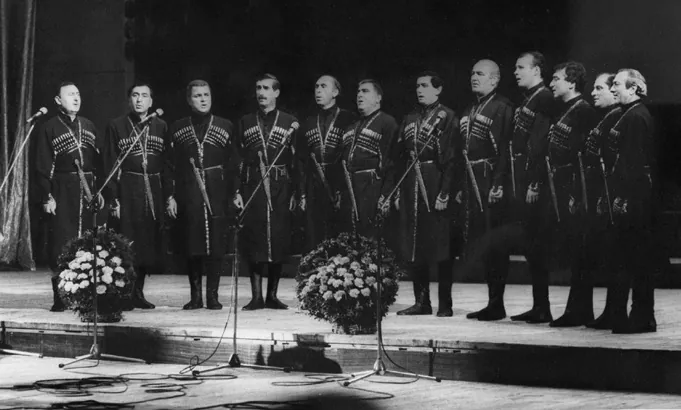
“The songs come from the depths of their souls... They exert all their strength and seem to pull the soul out of their bodies to make us listen to quite understandable sounds,” is how the German scientist Eduard Eichwald, who traveled to Georgia in the 1920s, described Georgian singing after hearing Georgians perform.
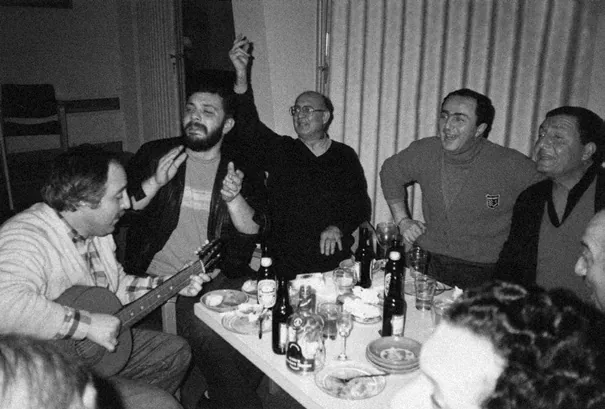
Georgian Supra: Gastronomy, traditions, wine, the Tamada (toastmaster), and toasts are integral parts of Georgia’s national culture. The musical embellishment of table gatherings is a distinctive aspect of Georgian culture. In ancient times, the repertoire accompanying the traditional Georgian table primarily included poly- phonic table songs and folk hymns, with Mravalzhamieri occupying a prominent place.
Mravalzhamieri – “A song with a wish for a long life and a sea of happiness.” This is the name of both a table song and a church hymn. Its meaning and essence convey longevity and enduring happiness. At the end of the Divine Liturgy, singers often perform Mravalzhamieri from various parts of Georgia in church.
Thematically, Mravalzhamieri is closely associated with regions rich in grape varieties and winemaking traditions. In eastern Georgia, the song is found in Kakheti, Kartli, and Meskheti. In the East, both long and short versions of Mravalzhamieri are performed. These versions are characterized by a sustained bani (drone), against which high voices alternate or sometimes harmonize simultaneously.
The performance style is distinguished by melismatic ornamentation, with intricate vocal twists. The songs gain a unique character and emotional depth from tonal shifts, gradual rises in pitch, and the diverse content of the lyrics, which explore themes of life and death, enmity and love, homeland and honor. In western Georgia, Mravalzhamieri is widespread in Racha, Imereti, Samegrelo, Guria, and Adjara. Here, most versions of Mravalzhamieri are hymn-like, although, unlike hymns, they often begin with a single voice and develop freely, sometimes with contrasting vocal lines.
Notably, in all regions, the song is distinguished by angular performance styles and variations in the main text.
Beyond its function as a song, Mravalzhamieri also serves as a blessing—a wish for longevity and prosperity. Over the centuries, it has actively expressed the people’s desire for freedom and victory over enemies, as reflected in the lyrics: “I will die, the sword follows me to cut off the enemy’s head.”
Mravalzhamieri holds such importance for Georgians that it has also become part of urban folklore. A key component of Georgian traditional music, urban folklore is divided into two categories: Eastern and Western. Eastern urban folklore developed in the cities of eastern Georgia from the 7th century, influenced by Eastern musical traditions, while Western urban folklore emerged in the 19th century, inspired by the popularity of European classical music. Urban Mravalzhamieri belongs to the cities of western Georgia, where its harmony reflects the regularity of European music and demonstrates the influence of European performance styles.
When discussing Georgian songs, it is essential to mention the legendary singer Hamlet Gonashvili, known as the “Voice of Georgia.” His unique timbre and virtuoso performance technique continue to captivate listeners today.
Gonashvili performed Kartli-Kakhetian and Imereti-Guruli songs, hymns, and works by Georgian composers with equal success. His artistry represents a synthesis of a deep connection to folk roots and the aesthetic influences of both Georgian and Western European classical music. Over time, the songs he performed have gained increasing popularity worldwide. Foreign filmmakers and directors often use Hamlet Gonashvili’s Urmuli and Orovela in films and major performances, considering them a mystical phenomenon—a unique expression of the human voice.