History and Varieties of Georgian Cheese
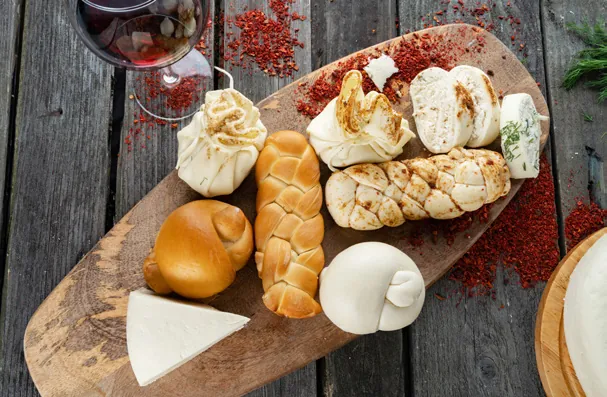
Cheese is an essential ingredient in Georgian cuisine, deeply embedded in the country’s gastronomic culture. You might be surprised to learn that Georgia is home to about 60 unique and distinct types of cheese. Cheese-making in Georgia is considered a ritual, traditionally carried out by women in family settings. Many of these cheeses have earned a place on Georgia’s list of intangible cultural heritage monuments.
Narchvi: A Svanetian Tradition – Narchvi cheese hails from Svaneti, with its name meaning “gathered.” The preparation of Narchvi begins in the summer and takes nearly two months to complete. During this time, cows graze on fresh grass, ensuring high-quality milk. Narchvi is a cheese preserved for the winter. The cheese is cut into pieces, salted, and kneaded into a homogeneous mass. It is then stored in a box made from thin planks of deciduous wood, covered with cloth, and weighted to allow excess liquid to drain. The cheese is left in the dark to ripen and reaches perfect maturity by Christmas. Narchvi has a creamy, buttery flavor, is not overly salty, and can be enjoyed dry at dinner or as a filling for khachapuri. It also serves as the base for the delicious Svanuri Chvishtari.
Guda Cheese: A Tushetian Specialty – In Georgia, particularly in Tusheti, you’ll find Guda cheese. Tushetian Guda cheese is made exclusively from sheep’s milk or a mixture of sheep’s and cow’s milk. This raw, unpasteur- ized cheese is ripened in a Guda made from sheepskin, where 4-5 cheese heads are placed with layers of salt between them. The Guda is tied and covered with cloth to allow the salt to settle evenly. The cheese heads are turned several times daily, and their shape is adjusted. Using this method, the cheese ripens in the Guda for 60 days, developing its distinctive flavor and texture.
Tenili Cheese: A Meskhetian Masterpiece – Meskhetian Tenili cheese is unique in both shape and taste. Made from sheep’s or cow’s milk, it is known for its distinctive fat content. The cheese is spun in hot whey until it takes on a thread-like form. It is then washed in cold salted water and left to dry for a day. Once dried, it is cut, rolled in cream, and placed in a clay pot to ensure no air enters. This process gives the cheese its name, “Tenili.” After being placed in the clay pot, a layer of cloth is added on top, and the pot is turned upside down onto sifted holy ash. This ensures that the cheese remains free of moisture and matures for at least two months, achieving its characteristic rich and tangy flavor.
Sulguni: The Soul of the Georgian TableSulguni cheese is truly the “soul” and “heart” of the Georgian table. The people of Samegrelo and Svaneti are credited with being the first to make Sulguni. This cheese is made from freshly milked buffalo or cow milk. The process involves kneading the cheese mass, shaping it into a low cylinder, and salting it. The result is a flaky cheese with a slight crunch when cut. Sulguni comes in various forms—fresh, dry, aged, smoked, or infused with traditional spices, honey, or even wine—offering a wide array of flavors and textures.
Imeruli Cheese: A Hand-Cured Tradition – To conclude, we must mention Imeruli cheese, a hand-cured specialty. Fresh milk is curdled by adding a “cheese mother” (curd) and heating it gently. Once the milk curdles, it is stirred by hand to start forming the cheese mass. Excess whey is removed slowly through hand-squeezing, but enough moisture remains to ensure proper ripening. The rounded cheese is then placed in a clay or wooden mold. For instance, cheese curdled in the morning is left in a bowl until the evening, then mixed with rock salt. Once salted and set, the cheese is preserved in brine, where it continues to develop its mild yet rich flavor.