Wild, Soulful, Unforgettable: a Journey Through Corsica
Some trips begin with a plan and end up somewhere else entirely. Ours began with a single, specific goal: finding a wedding destination away from the overexposed, the overly Instagrammed, somewhere with wild nature and real soul. Corsica had been on my mind for years, though I had never actually made it there. This time, I decided not just to visit, but to travel the length of the island and explore it properly, from the seaside to the mountains, the popular corners to the ones almost no one talks about. The whole trip came together in just two weeks, and what we found was something far bigger than a venue. We found an island so fiercely its own that, more than once, I forgot I was technically still in France.
Getting there was its own small adventure. From Tbilisi, we took the direct Georgian Airways flight to Nice, before choosing the slower, more romantic route onward: an overnight ferry from Toulon, boarding with the car we’d rented. We watched the sunset from the deck, slept in our cabin, and woke up in the port of Ajaccio, Napoleon’s hometown, where streets and squares still carry his name and that of his wife Josephine. His childhood home, now a museum, is worth the stop before heading onward.
The first thing that struck me on arrival wasn’t a sight at all. It was a scent: wild herbs, sea breeze, sun-warmed earth, with a pinch of something harder to name. If I had to describe the island in five words, they would be wild, authentic, soulful, strong-spirited, and very tasty.
NORTH ALONG THE COAST
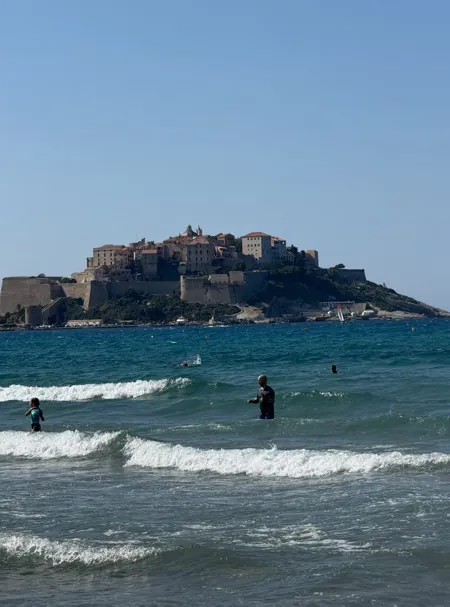
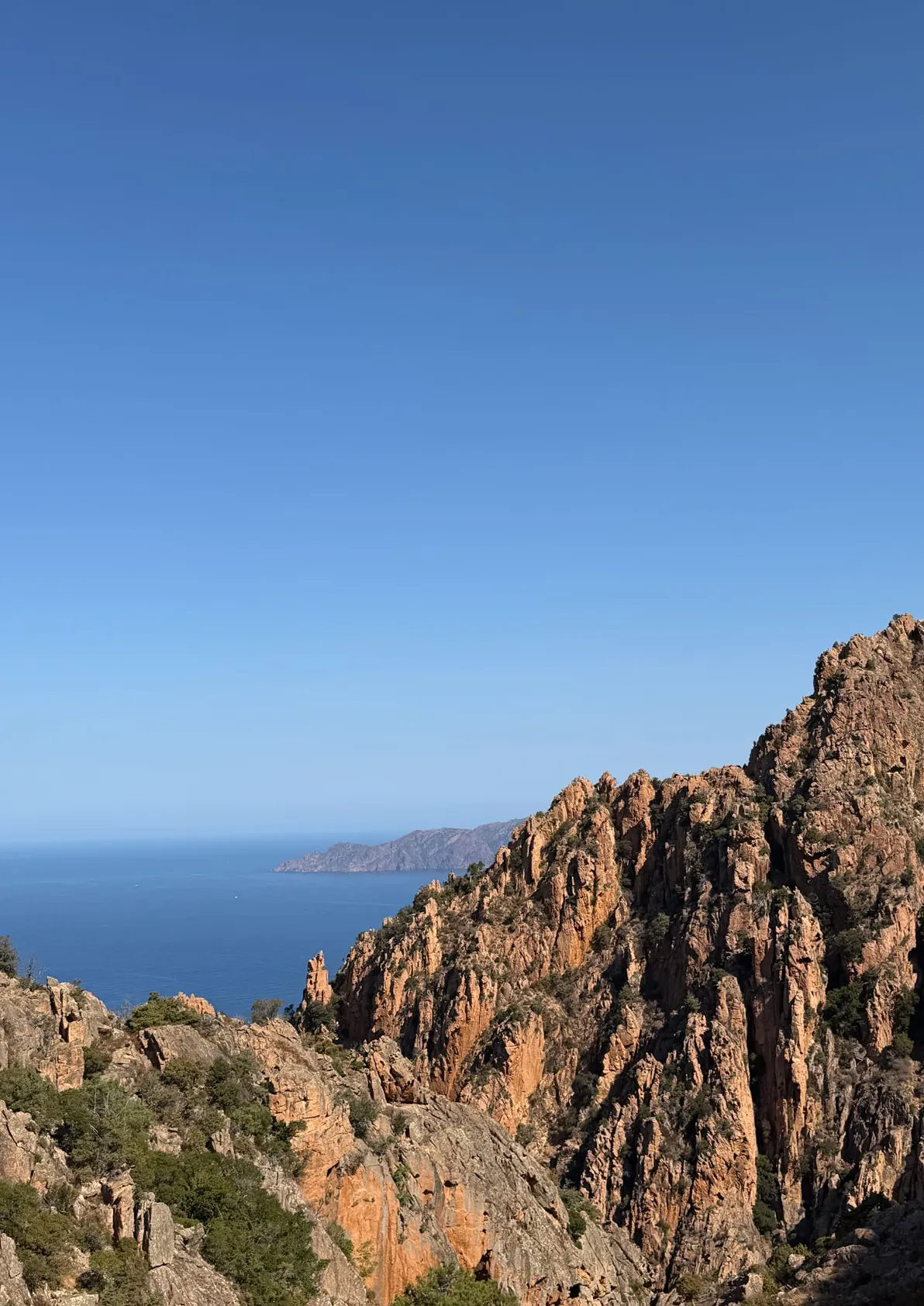
From Ajaccio, the road to Calvi unfolds as one of the most beautiful drives I’ve ever taken, winding past the Calanques de Piana, where dramatic pink and red cliffs plunge into the sea. It’s a UNESCO World Heritage Site for good reason; photographs don’t quite prepare you for the scale of it. Calvi itself has a lovely beach, a charming port, and a citadel worth wandering for an afternoon, and nearby, the hilltop villages of Sant’Antonino and Pigna are full of genuinely handmade Corsican craftsmanship, worth seeking out if you want something to bring home that actually means something.
SOUTH TO PORTO-VECCHIO, AND MURTOLI
From the north, we made our way south to Porto-Vecchio, reuniting with friends for a dinner that stretched long into the evening in that particular way only a charming small town allows.
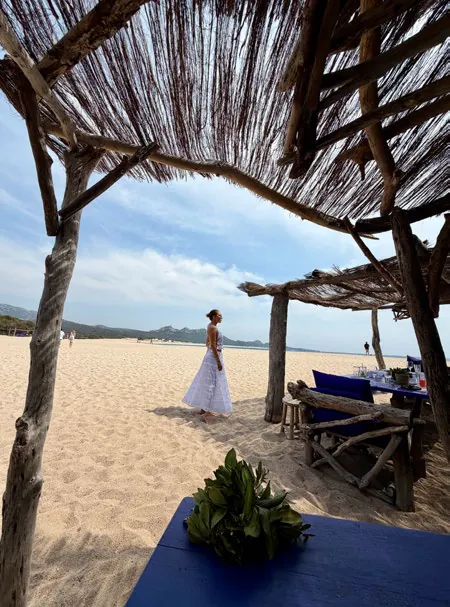
But the following day brought the place that, looking back, defined the entire trip: Domaine de Murtoli. We’d planned two nights. It wasn’t nearly enough. Murtoli is one of those rare places that seems to hold the whole soul of Corsica inside its boundaries: 2,500 hectares of wild maquis, olive groves, and private coastline, its old stone shepherd’s houses restored with such care that they feel untouched rather than renovated. It is, without question, far more than a hotel. It’s a feeling, and a way of living, slower and more deliberate than almost anywhere else I’ve stayed. I’ll tell that story properly elsewhere in this issue, because it deserves the space.
INTO THE MOUNTAINS
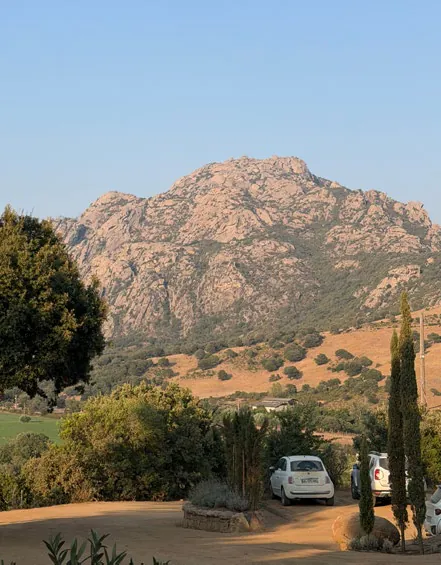
Corsica surprised me most, perhaps, in its interior. From Murtoli we drove into Zonza, deep in the island’s mountainous heart, where forests and lakes replace the coastline entirely, and the hiking is some of the best I’ve encountered anywhere in the Mediterranean. It’s easy to come to Corsica only for its beaches and never realize that the island is, at its core, a mountain rising out of the sea. Sometimes all it takes is an hour’s drive inland, with no particular plan, to find a version of Corsica you couldn’t have imagined from the coast.
It was here, too, that the similarities to Georgia became impossible to ignore. The pride and character in every Corsican we met, the mountains themselves, the warm, home-style cooking, all of it felt familiar. One evening in Bonifacio, we wandered into a concert inside a medieval church and heard polyphonic singing so close to Georgian tradition that for a moment I genuinely thought they were singing in Georgian. Like Georgians, Corsicans hold family, land, and tradition close, and it shows in everything from their food to the way they welcome strangers. Despite its political status, Corsica never once felt French to me. It has its own language, Corsu, its own rhythm, and a spirit entirely its own.
THE TASTE OF CORSICA
If one meal captured the island for me, it was at Ferme-Auberge A Pignata, a family-run restaurant in the mountains with no menu at all; you simply eat whatever has been prepared that day. The atmosphere is warm and unpretentious, and the food, impossible to fully describe, tasted like someone’s home rather than a restaurant. Wild boar appears often on Corsican tables and is worth seeking out wherever you find it.
Wine, too, became an unexpected highlight. We were lucky enough to try Tarra d’Orasi, one of Corsica’s rarest reds, produced by Clos Canarelli in Figari in the island’s south. Its vines are roughly 140 years old, planted in sandy soil and still growing on their original roots, having survived the phylloxera epidemic that wiped out most of Europe’s vineyards in the 19th century. Made in tiny quantities from ancient Corsican grape varieties, mainly Sciaccarellu and Minustellu with a touch of Cinsault, it’s quite literally a piece of Corsican history in a glass.
JOURNEY’S END, IN BONIFACIO
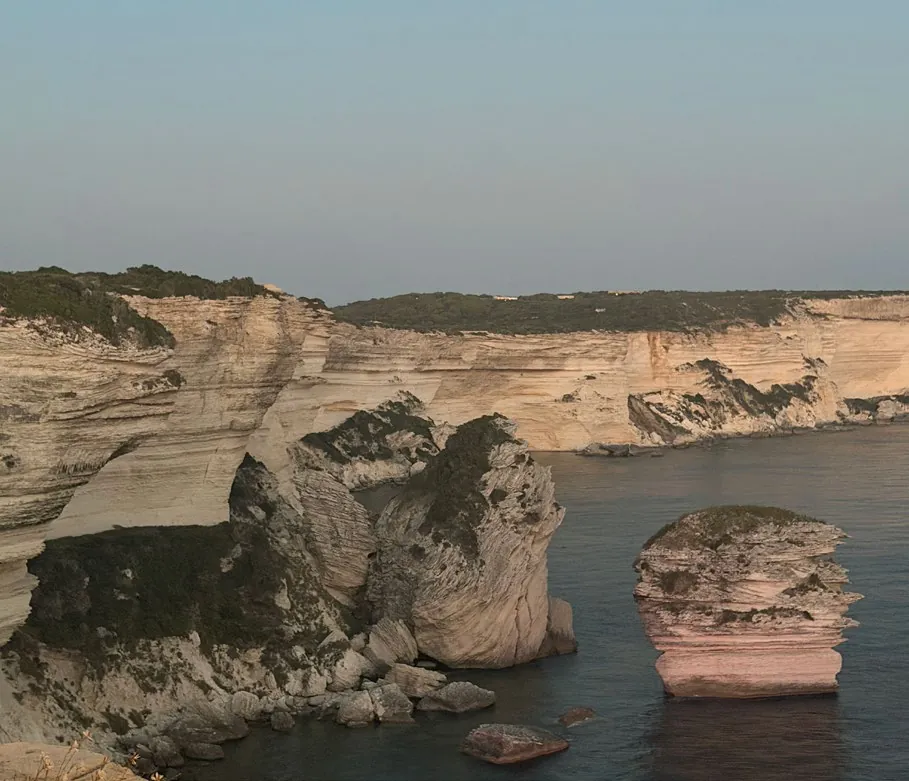
Our final stop was Bonifacio, perched dramatically at Corsica’s southernmost tip, facing Sardinia across the water. Its port is lined with restaurants, and its old citadel hums with its own vivid life, full of small shops, bars, and streets crowded with wanderers well into the evening. If you go, order the lasagna at La Caravelle. You won’t believe how good it is until you try it.
PRACTICAL NOTES
Corsica is home to roughly 355,500 permanent residents, with Corsu spoken alongside the official French, and visitors of every nationality, particularly from mainland France, mixing easily throughout the island. It’s a destination suited to nearly anyone, families, couples, groups of friends, or solo travelers chasing nature and culture in equal measure. We visited in summer and found it close to perfect, though I suspect autumn, with the mountains turning color, would be just as striking. Packing is refreshingly simple: Corsica is an island that asks you to leave the heels, and the need to dress up, at home.
Would I go back? Without hesitation. There’s still the island’s northern tip to explore, and boat trips to beaches along the coast that remain, for now, just out of reach. Some places you visit once. Corsica, I suspect, is one you keep returning to.
ELLEN’S CORSICA SHORTLIST
Favorite hotels
• Grand Hotel Cala Rossa
• Domaine de Murtoli
Favorite restaurants
• Sunday brunch at Murtoli’s beach restaurant
• Dinner at La Table de la Grotte at Murtoli, set inside a cave, and the place to try Tarra d’Orasi
• Ferme-Auberge A Pignata, in the mountains
• La Caravelle, in Bonifacio
Follow Ellen’s travels on Instagram [@ellendumbadze]
• Grand Hotel Cala Rossa
• Domaine de Murtoli
• Ferme-Auberge A Pignata, მთებში
• La Caravelle, ბონიფაჩოში