The Oldest Books
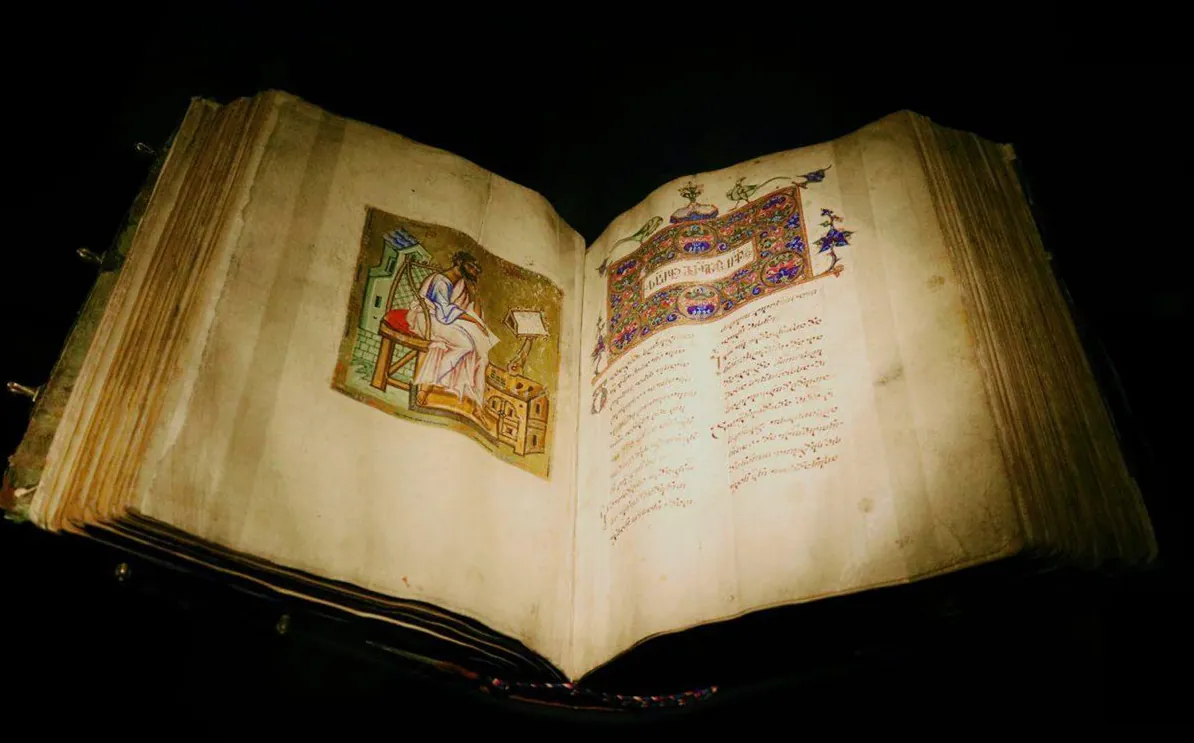
Today, books are such an ordinary part of everyday life that it is difficult to imagine a time before they existed. Yet the human desire to preserve knowledge, beliefs, and stories for future generations is far older than the book itself. The earliest texts were written on a variety of materials, and over time, binding pages together gave rise to the form of the book we know today.
That is why the question “What is the oldest book in the world?” has no single, simple answer. It all depends on what we mean by a book: the oldest surviving manuscript codex, the oldest complete book, or the earliest dated printed edition.
One of the most important early codices is the Codex Sinaiticus, dating from the middle of the fourth century. Written in Greek on parchment, it is one of the oldest surviving manuscripts containing an almost complete text of the Christian Bible. Its surviving portions are now held by four institutions: the British Library, Leipzig University Library, the National Library of Russia, and Saint Catherine’s Monastery.
Several centuries later, in the early eighth century, the St Cuthbert Gospel was created. This small book contains the text of the Gospel of John and survives to this day in its original binding. The British Library’s official catalogue describes it as the oldest intact European book. Its script dates to approximately 710–730, while the decoration of its covers dates to around 700–730.
But the history of the book is not limited to manuscripts. One of its most important turning points came with the development of printing – and for this chapter of the story, we must look not to Europe, but to China.
The Diamond Sutra, produced in China and dated May 11, 868, is, according to the British Library’s International Dunhuang Programme, the world’s earliest dated printed book. Its text was printed from woodblocks onto seven sheets of paper, which were then joined to form a scroll approximately five meters long. A colophon at the end records both the precise date of its creation and the name of its sponsor, Wang Jie.
In Europe, one of the best-known turning points in the history of the book came in the fifteenth century. The Gutenberg Bible, printed in Mainz around 1454–1455, was the first major typographic Bible produced in Europe. The Library of Congress notes that the exact date on which its printing was completed has not been definitively established. Available evidence dates it to around 1454–1455.
Perhaps the most remarkable thing about the world’s oldest books is not their age, but their survival. Letters written on parchment, bindings assembled centuries ago, and pages copied by hand still connect us with people who lived hundreds, and in some cases more than a thousand, years before us.
The form of the book continued to change: the scroll gave way to the codex, manuscripts to printed editions, and different writing materials were gradually replaced by more practical ones. But one human desire remained unchanged: that words should not be lost.