The Diamond of the Langhe
A SEASON INSIDE ALBA’S WHITE TRUFFLE COUNTRY. THE HUNT, THE HILLS, WHERE TO STAY AND EAT, HOW TO PLAN THE TRIP, AND A QUIET POSTSCRIPT FROM THE FORESTS OUTSIDE TBILISI.
WHERE AUTUMN TURNS TO GOLD
There is a particular hour, somewhere between the last vineyard workers going home and the first restaurant lights coming on, when the Langhe smells unmistakably of autumn: wet earth, woodsmoke, and something else entirely, something that has drawn buyers, chefs, and the merely curious to this corner of Piedmont for the better part of a century.
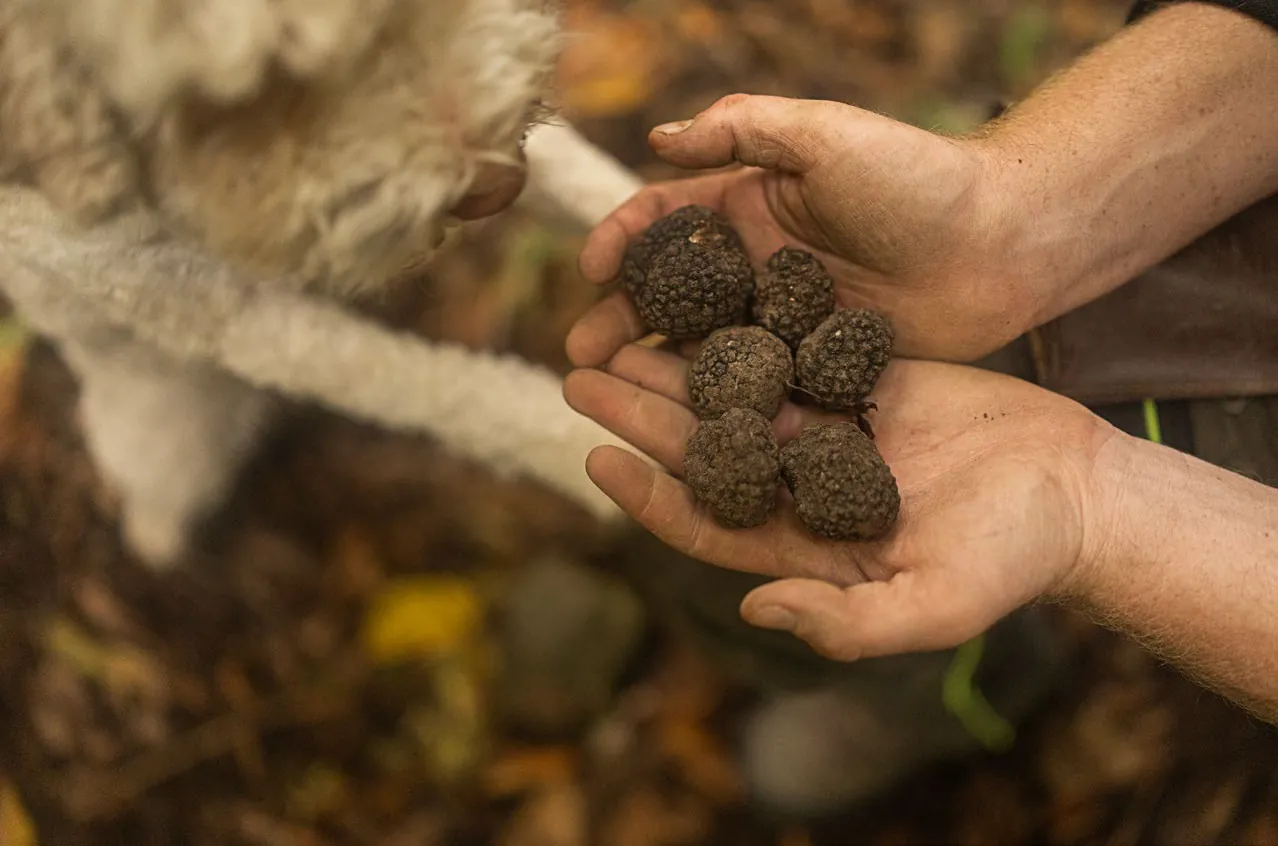
Each October, the hills southeast of Turin fill with a particular kind of anticipation. The temperature drops, the fog settles into the river valleys overnight, and somewhere beneath the roots of an oak, a poplar or a willow, a knob of fungus the color of pale clay is quietly reaching the end of its short, secretive life. This is Tuber magnatum Pico, the white truffle of Alba, and for roughly three months a year, it turns a modest market town in Pied- mont into one of the most closely watched addresses in the culinary world.
Unlike its black cousins, the white truffle has never been successfully cultivated. It grows only where it chooses, in the calcareous clay soils of the Langhe, Roero and Monferrato hills, a landscape now protected as a UNESCO World Heritage site for its vineyards as much as for what lies beneath them. The composer Gioachino Rossini is said to have called it “the Mozart of mushrooms”; a Turin physician named Vittorio Pico gave it its Latin name in 1788, borrowing from magnatus, a word for lords and men of consequence. Both nicknames still feel accurate. A single truffle can sell for hundreds of euros; a good one, at auction during the annual fair, for a great deal more.
That fair, the Fiera Internazionale del Tartufo Bianco d’Alba, runs on autumn weekends from early October into early December, and it is worth timing a visit around it. Alba’s medieval center fills with market stalls, truffle auctions, cooking demonstrations and the odd costumed procession. It was a local innkeeper, Giacomo Morra, who did more than anyone to put the fair, and the truffle itself, on the world’s map: in the mid-twentieth century he began mailing white truffles to Winston Churchill, Marilyn Monroe, Alfred Hitchcock and even Pope Paul VI, a marketing instinct that still shapes how Alba sells itself. His shop, Tartufi Morra, has traded from the same town since 1930.
THE HUNT
A GOOD HUNTING GROUND IS INHERITED THE WAY A FAMILY RECIPE IS INHERITED: QUIETLY, AND RARELY IN WRITING.
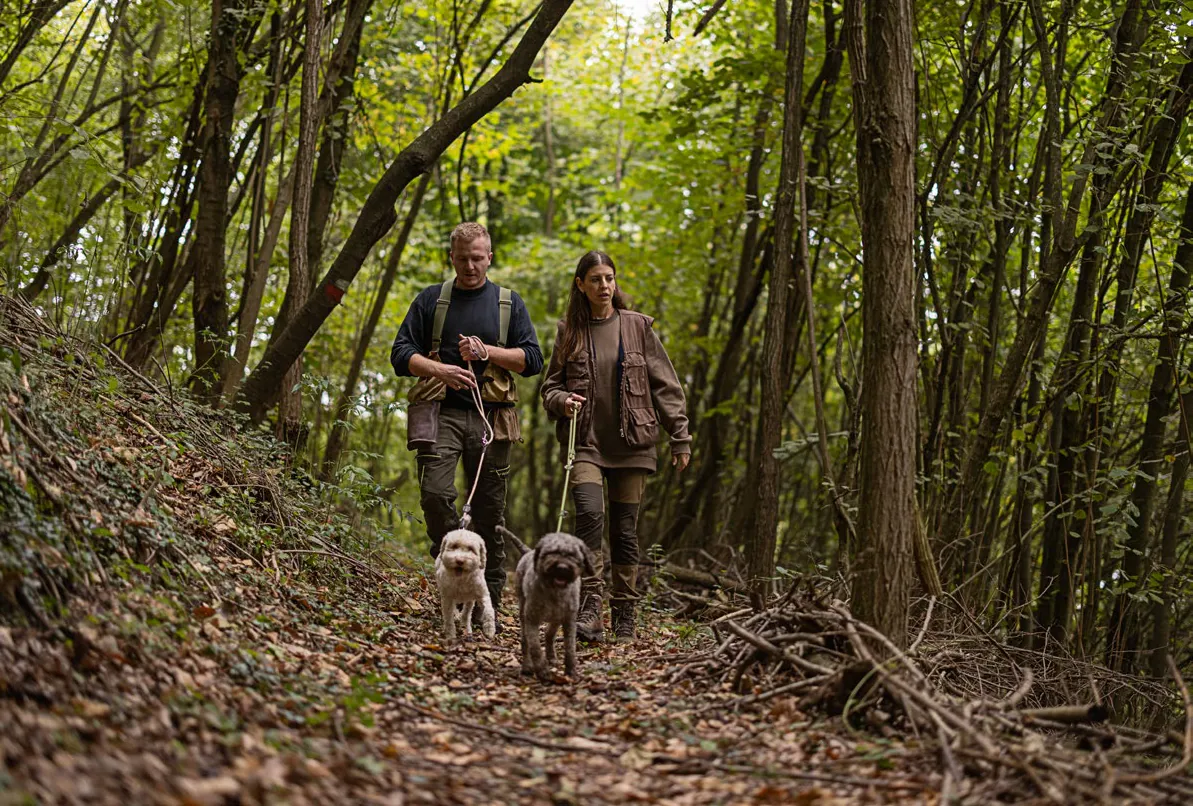
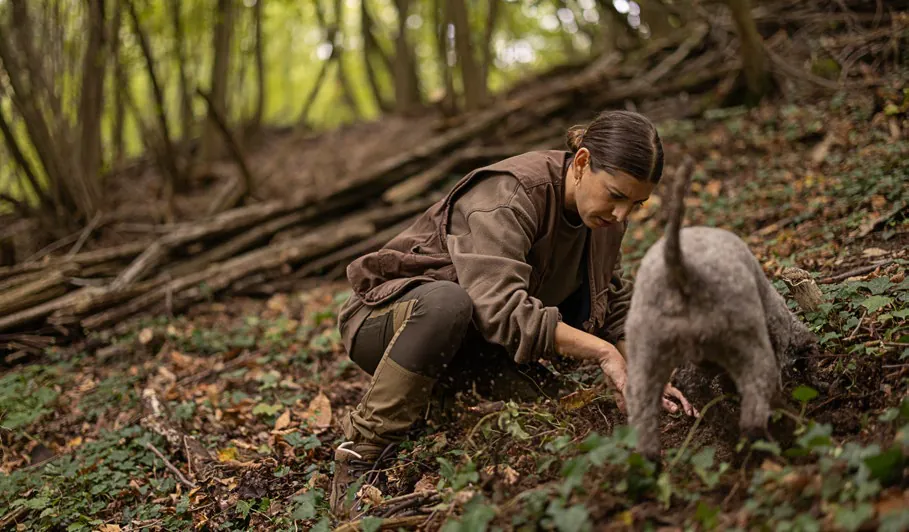
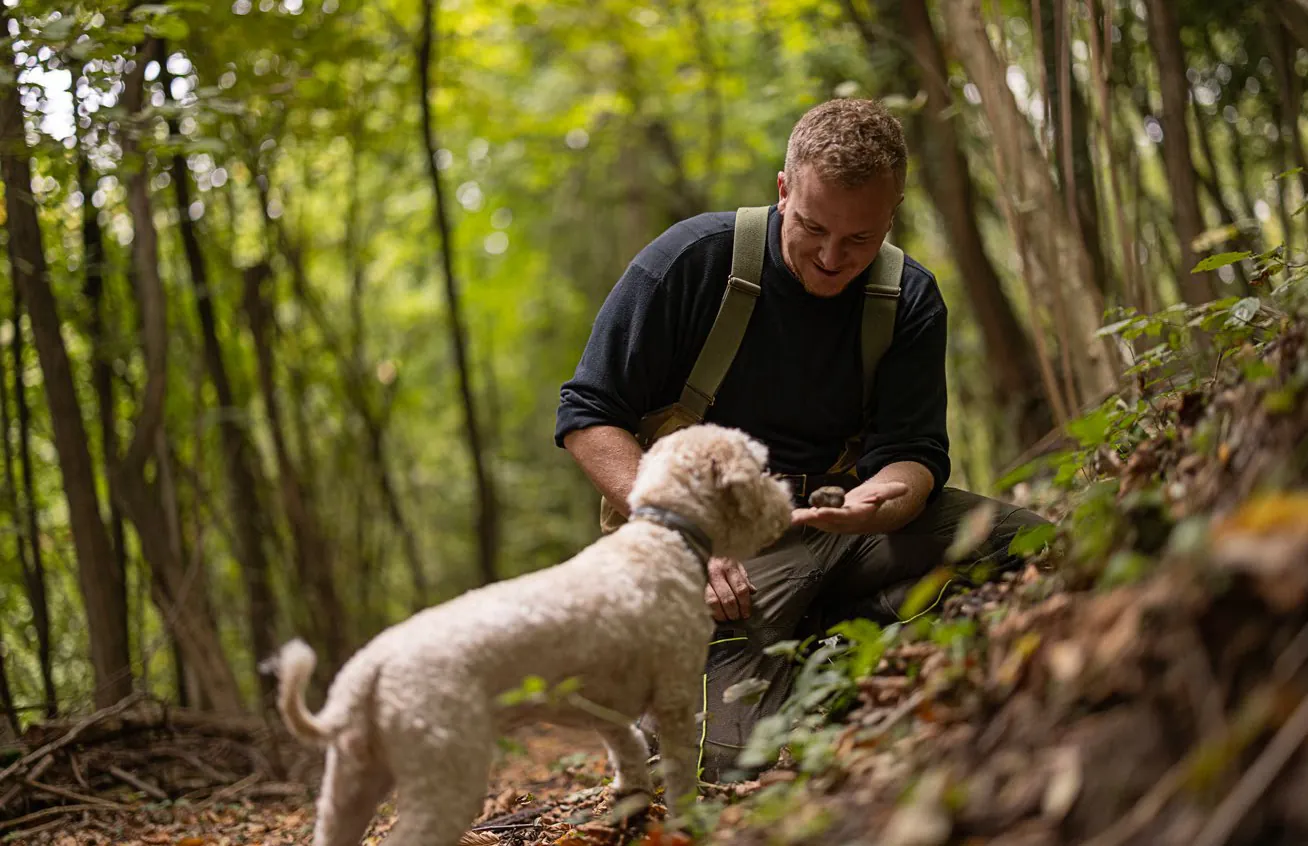
Truffle hunters here are called trifulau in Piedmontese, tartufai in Italian, and the title still carries a certain folkloric weight. Traditionally they worked at night or in the grey hour before dawn, partly because the truffle’s scent is easier for a dog to read in cool, still air, and partly to keep good ground secret from rival hunters. Pigs did this work for centuries; dogs, usually the curly-coated Lagotto Romagnolo, have long since replaced them, being both more precise and considerably less inclined to eat the evidence.
The trade is tightly regulated by regional law, with licensing requirements and defined seasons for each truffle variety. The white truffle’s window runs roughly from late September to the end of January, with black and summer varieties governed by their own calendars. Because a hunter’s productive patches are treated as closely guarded family property, many of the truffle hunts sold to visitors are respectful simulations rather than the real, secretive thing. A smaller number of local operators, often based in the Langhe itself, do lead genuine hunts, best booked well ahead of an autumn visit.
THE UNIQUE CORNERS OF THE LANGHE
Alba itself is the natural hub, a compact, arcaded old town built around the Piazza Risorgimento and the Cattedrale di San Lorenzo, with the truffle market spilling down Via Vittorio Emanuele on fair weekends. But the region rewards slower detours:
La Morra, perched on a ridge above the vineyards, offers arguably the single best panorama of the Langhe: a patchwork of vines running to the horizon, particularly striking at golden hour. The village of Barolo itself is smaller than its fame suggests, built around the Castello Falletti, which now houses WiMu, an imaginative wine museum worth an hour on its own. Just across the way sit the historic cellars of Marchesi di Barolo, where the modern Barolo style was effectively invented two centuries ago and where the Abbona family still ages wine in the same vaulted rooms today. Monforte d’Alba, arranged in an amphitheater of stone lanes, hosts a well-regarded summer jazz festival and some of the area’s most quietly excellent restaurants. Grinzane Cavour’s moated castle, once home to the statesman Camillo Cavour, doubles as a regional enoteca stocking hundreds of Piedmontese labels under one roof, along with its own Michelin-starred dining room. Further east, Barbaresco and Neive form a second axis built on the Nebbiolo grape, with a medieval tower in Barbaresco offering views to rival La Morra’s. Serralunga d’Alba, with its needle-thin castle visible for miles, anchors a cluster of the region’s most decorated tables. And to the north, the sandier, wilder Roero hills, cut through with eroded cliffs known as le Rocche, hold onto more of the old forest cover than the vine-dense Langhe, which is one reason serious hunters still favor them.
GETTING THERE, AND WHAT TO EXPECT
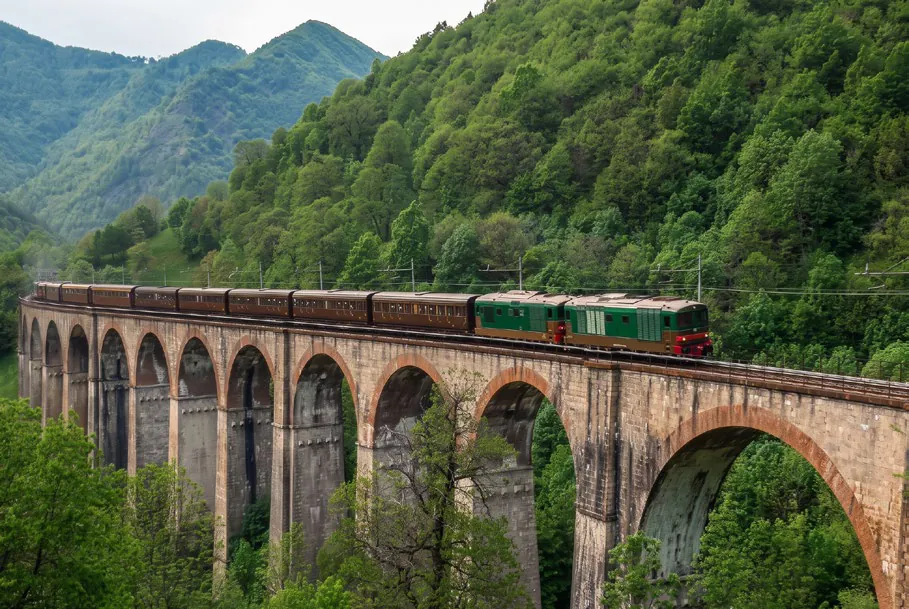
For travelers flying in on Georgian Airways, both Rome and Milan are natural gateways for this trip, and this autumn, the approach to truffle country can be an expe- rience in itself either way. Rome and Alba are connected by an evocative new departure: the Espresso Langhe Monferrato, a vintage-style sleeper train launching this October as part of FS Treni Turistici Italiani, the Italian national railway’s growing roster of nostalgic rail journeys. Board in the evening in Rome, settle into a refurbished mid-century sleeper cabin over a gourmet onboard dinner, and let the train rock you to sleep as it winds north through the Italian countryside overnight. Fares on FS’s Espresso sleeper routes run roughly €200–€400 round trip for a shared couchette and €300–€500 for a private cabin, depending on occupancy and season.
You wake up in truffle country. The train times its arrival for the Alba White Truffle Fair season, so stepping off the platform can mean stepping almost directly into the market stalls, cooking demonstrations, and truffle-hunting excursions that fill the town’s medieval center each weekend from mid-October through early December. It’s a slower, more romantic approach than a connecting flight and a rental car, and it turns the journey itself into the first chapter of the trip rather than a logistical prelude to it.
A car is not strictly necessary once you’ve arrived if you’re basing yourself in Alba and hiring drivers or tour operators for hunts and winery visits, but it opens up the smaller villages considerably and is the only practi- cal way to string together a multi-day route through the Langhe, Roero and Barbaresco in one trip. It’s worth arranging for pickup at the Alba station if the sleeper train is your way in.
Passengers connecting through Milan have their own version of the same idea. FS Treni Turistici Italiani, the operator behind the Rome sleeper, has also revived a historic Milan–Alba day service for the same truffle season, running on selected Sundays this autumn aboard restored 1970s-era Gran Confort carriages. The train leaves Milano Centrale at 9:05 a.m., threads through Pavia, Alessandria and Asti, and arrives in Alba by 12:35 p.m., with tastings and talks on Nebbiolo and local tradition on board along the way, before an evening return departing Alba at 6:20 p.m. and reaching Milan by 10 p.m. Round-trip tickets are €92 for adults and €46 for children aged four to twelve. It’s a full day in the Langhe rather than an overnight, so it suits a shorter visit or a first taste of the region before committing to a longer stay.
As for what to expect: book everything, including the sleeper train, hotels, hunts, and especially restaurant tables, well in advance if traveling during October and November weekends, when the truffle fair draws crowds from across Italy and beyond. Weekdays, and the tail end of the season in December, are calmer and often cheaper, and locals will tell you the truffles are at their best precisely when the crowds start to thin. Pack for damp, cool weather and mud underfoot regardless of what the forecast promises, and expect the region to run at its own unhurried pace. Reservations are taken seriously, but so is a long lunch.
WHERE TO STAY
The Langhe’s best addresses tend to be small and design-conscious rather than large and anonymous, often built into former farmhouses, monasteries or castles.
• Casa di Langa (Cerretto Langhe): 5 stars, roughly €380–€430/night, a contemporary countryside resort with its own spa, kitchen garden and restaurant, a short drive from Alba
• Relais San Maurizio (Santo Stefano Belbo): 5 stars, roughly €350–€490/night, a former eighteenth-century monastery converted into a spa relais, consistently ranked among the region’s finest
• Hotel Villa Beccaris (Monforte d’Alba): 4 stars, roughly €245–€300/night, an eighteenth-century patrician villa turned boutique hotel with a pool terrace over the vineyards
• Hotel Castello di Sinio (Sinio): 4 stars, roughly €245– €335/night, a restored twelfth-century castle sitting between the Barolo and Barbaresco appellations
• Villa d’Amelia (Benevello): 4 stars, roughly €180– €270/night, a nineteenth-century farmhouse turned countryside hotel, home to a Michelin-starred dining room
• Il Boscareto Resort (Serralunga d’Alba): 5 stars, roughly €410–€525/night, a spa resort at the foot of the village’s landmark castle, with its own starred restaurant, La Rei
Rates above are indicative, high-season nightly averages for a double room and will shift with dates and demand. Worth confirming directly before booking.
WHERE TO EAT
This is, gram for gram, one of the most decorated dining landscapes in Italy, and truffle season is when its kitchens perform at full stretch.
Piazza Duomo, in Alba, holds three Michelin stars under Chef Enrico Crippa and runs a dedicated white-truffle tasting menu each autumn. Book weeks ahead. Its sister restaurant one floor down, La Piola, serves the same tajarin al tartufo and raw beef battuta in a far more casual, walk-in-friendly osteria. In Treiso, La Ciau del Tornavento pairs a starred, vineyard-view dining room with a cellar of some sixty thousand bottles. Guido Ristorante, inside the Fontanafredda estate at Serralunga d’Alba, and
Marc Lanteri’s dining room inside the castle at Grinzane Cavour both make a meal out of the setting as much as the plate. For something quieter, Trattoria della Posta in Monforte d’Alba and Lalibera in Alba deliver classic Langhe cooking, tajarin, agnolotti, Fassone beef, bagna cauda, without the tasting-menu theatre. Whichever table you choose, the dish to order in autumn is simple: something plain enough for a generous shaving of fresh white truffle to be the point.
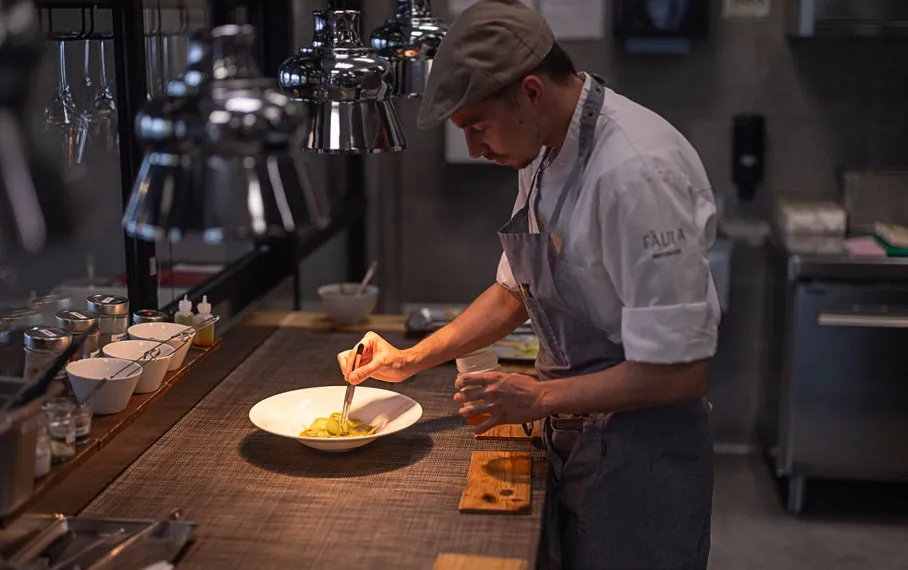
At Casa di Langa, Faula Ristorante is entering a new chapter of its own under newly appointed Executive Chef Francesco Clerico, a Langhe native born in nearby Monforte d’Alba. His arrival coincides with the region marking 40 years since the birth of the Slow Food movement, the local-food, anti-fast-food philosophy founded just down the road in Bra in 1986, now a global network with members in more than 160 countries, and Clerico’s menu leans further into estate-grown produce and regional biodiversity as a result.
A FOUR-DAY ITINERARY FOR TRUFFLE SEASON
This is a region built for slow travel by car, with no single base more than forty minutes from any other. A four-day arc through it might look like this:
DAY ONE: ALBA
Arrive and settle in with an unhurried walk through the old town. If it’s a weekend during the fair, spend the morning at the truffle market on Via Vittorio Emanuele, watching the quality commission inspect purchases before they change hands. Stop into Tartufi Morra for truffle butter and oil to take home, then book a table for dinner serving tajarin al tartufo bianco.
Casa di Langa (Cerretto Langhe), see Where to Stay, above
DAY TWO: INTO THE WOODS, THEN BAROLO
An early start for a guided truffle hunt through Langhe woodland with a trifulau and dog. Dress for mud regardless of the weather. In the afternoon, head to Barolo village for the WiMu wine museum inside the Castello Falletti, followed by a cellar tour and tasting at Marchesi di Barolo. The estate’s historic vaults sit just off the same square, and the guided walk through two centuries of Barolo winemaking pairs naturally with WiMu’s more playful, museum-style take on the same story. Round out the day with a stop in La Morra as the light turns gold over the vines.
Hotel Villa Beccaris (Monforte d’Alba), see Where to Stay, above
DAY THREE: GRINZANE, BARBARESCO AND NEIVE
Spend the morning at Grinzane Cavour’s castle and re-
gional enoteca, then drive east to Barbaresco for its tower and a cellar visit, continuing on to the quieter, equally handsome village of Neive. Dinner tonight is the occasion for the tasting menu you’ve been saving room for.
Relais San Maurizio (Santo Stefano Belbo), see Where to Stay, above
DAY FOUR: THE ROERO, AND DEPARTURE
Before heading back toward Rome for onward travel, spend the morning walking a stretch of the Rocche del Roero, the sandy, eroded cliffs north of the river, for a very different, wilder landscape than the vineyard hills you’ve just left. A last truffle-scented brunch is the appropriate send-off.
A NOTE ON THE SAVINI NAME
Any conversation about the truffle trade eventually arrives at the name Savini. The family has hunted and dealt in truffles from their base in Tuscany for four generations, since the 1920s, and is widely known as one of the trade’s most trusted selectors and buyers, including of Alba white truffles. The family also brokered a record-setting truffle sale worth roughly €300,000 in 2007.
A POSTSCRIPT, FROM THE CAUCASUS
It’s tempting, writing about truffles, to treat the ritual as an exclusively Italian inheritance: fog, dogs, and centuries of family secrecy. But roughly a decade ago, in a patch of forest near Tsavkneti, just outside Tbilisi, a Georgian named Aleksandre Siamashvili found something unexpected underfoot: the country’s first documented black truffle. He has since turned the discovery into a small but serious profession, leading hunts of his own with a Lagotto Romagnolo, the same breed at work in the Langhe, through the forests above the capital.
Georgian black truffle has begun quietly finding its way onto Tbilisi menus since, showing up in dumplings, sauces, and alongside suckling pig at some of the city’s better contemporary restaurants. A handful of gastronomic tours now run truffle-hunting excursions into the Georgian countryside each winter, timed to the same cold, damp weeks that bring the fog down over Piedmont. Georgia’s truffle story is still being written, younger by a hundred years than Alba’s, and without a Giacomo Morra yet to mail a specimen to a head of state. But the underlying instinct, the same patient trust between a person, a dog, and a rare thing that still refuses to be farmed, turns out not to belong to any one hillside at all.
PHOTO CREDIT: © ALEXANDER ZOLTAI