Di Meo Calendar 2025: Naples and Tbilisi, the Siren and the Panther
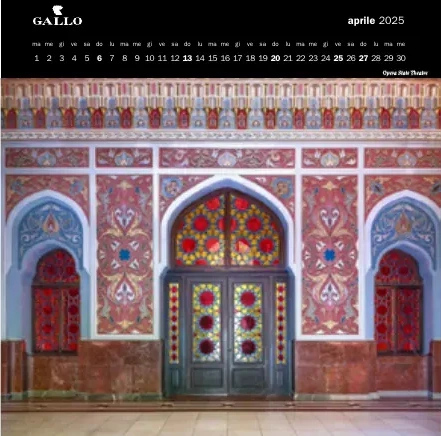
Naples meets Tbilisi, in the name of art, culture and solidarity. The prestigious Di Meo Calendar, promoted and produced every year by the ‘Di Meo vini ad arte’ Association, under the patronage of the Italian Presidency of the Council of Ministers, is now in its 23rd edition, this year also with the support of the Georgian Chanting Foundation.
The presentation of the Di Meo Calendar is now a much-awaited international event. It is meant to be a testimony to the values that inspire the Association and an opportunity, even in a difficult and painful historical period such as the present, to reaffirm the importance of dialogue between peoples and between different cultures. The overall sense of this initiative and its deeper meaning lie in the links woven between different cultural spheres, to contribute to a better mutual understanding.
‘I chose Tbilisi for the 2025 Calendar,’ says Generoso di Meo, the volcanic founder of the Association, ‘whose culture and civilisation has been neglected for many years by the West, which baselessly merged all the federated republics of the Soviet Union into an idea of “Russia”, neglecting their specificity and impressive variety and diversity, transfused into the literature, music and other artistic expressions of these peoples. A capital that has been, since the 5th century, a melting pot of the most diverse civilisations between East and West’.
Once again this year, the photos of Massimo Listri (http://www.massimolistri.com), who signed the calendar from 2013, will offer a visual reading of the city. With his gaze, he has been able to give it an unexpected light, restoring in the calendar all the narrative power of the Georgian capital, a symbol of art, culture and dialogue between peoples. Not only photos, but also tales and stories that tell of the points of contact between the city of Naples and Tbilisi. Thanks to the critical contribution of renowned scholars, the Calendar will investigate the most significant correspondences between Naples and Tbilisi: the Siren and the Panther. The symbol of the birth of Naples is, in fact, the siren Parthenope, and its inhabitants are still referred to as Parthenopeans, while Georgians have long identified with the myth of Tariel, at the centre of the beautiful poem ‘The Panther-skinned Knight’ by Šota Rustaveli, a national poet who lived in the 12th (century, equivalent to our Dante.
Numerous significant historical events link Naples and Campania to Georgia. An important point of contact is represented by wine, as recent archaeological excavations have also ascertained. It is no coincidence that the word for wine in western languages derives from the Georgian or, as linguists say, proto-Kartvelian, yvino. But there are many traditions that make the relationship between Naples and Tbilisi alive: the cult of love, the language of feelings, the propensity for emotion, the vocation for hospitality, the passion for poetry and conviviality, the love of football and the of the great champion Kvaratskhelia, whose contribution was decisive in Napoli’s winning of the third Scudetto; and again, the common art of leavening (pizza and khachapuri), the funicular railway in the two cities, the positioning of Tbilisi and Naples on the 41 parallel. In addition, the first chair of Georgian Language and Literature in Europe was established at the Orientale University in Naples.
In the study conducted by Generoso di Meo, it also emerged how much the two cities are united by elements of common culture: it is no coincidence that the Neapolitan nativity scene features, among the traditional characters, that of the Georgian woman, just as, for both, the passion for music is strong. If the tradition of Georgian polyphonic singing is the first case of ‘intangible heritage of humanity’ accepted by UNESCO, Georgia is also the land of great opera singers who have performed at the San Carlo theatre and of young talents in whom the Neapolitan Opera House has invested, promoting their growth through its Singing Academy.
The Di Meo 2025 Calendar, produced in 5000 copies, will be presented to the press and an important parterre of international cultural and business leaders in Tbilisi.
After having presented past editions in prestigious venues (such as the Royal Academy of Arts in London, the State Historical Museum in Moscow, the National Museum in Warsaw, the Kunsthistorisches Museum in Vienna, the Ajuda Royal Palace in Lisbon, the Çırağan Palace in Istanbul, the Palace of Serbia in Belgrade, the Alcázar in Seville, the Municipal House in Prague), the gala presentation of the Calendar will be held in October 2024 in the Mtatsminda Palace, which can be reached by the scenic Tbilisi funicular. The texts in the calendar were edited by Angela Catello, Cesare Cunaccia, Michele De Lucchi, Dante Stefano Del Vecchio, Dinko Fabris, Michele Fatica, Andrea Forlani, Patrizia Licini de Romagnoli, Luigi Magarotto, Elisabetta Moro, Veronique Murat, Gaga Shurgaia and Pino Taormina.
Calendar photos: Massimo Listri